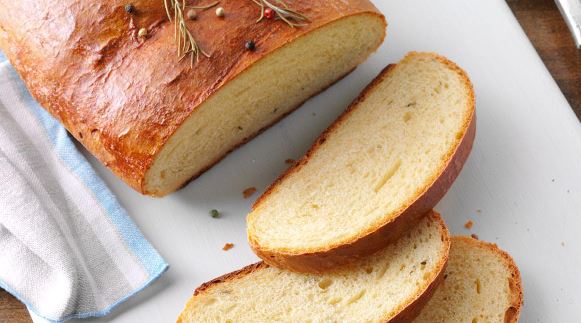
Why this recipe works The Auvergne Crown, or couronne auvergnate, is a large, crusty, ring shaped loaf made with white flour and leavened with a sourdough culture. It can be found in boulangeries throughout France, but it originated in the Auvergne region of central France, an area known as the source of most of the country’s grain. Unlike simple white breads, the Auvergne Crown is deeply flavorful, owing to its mildly tangy, aromatic sourdough starter and a long, slow fermentation process. We experimented with several approaches to forming this 100 percent white flour sourdough bread into its unique crown shape. We started by rolling the dough into a log, or folding it into a baguette shape, before bending it into a ring, but the results were inconsistent: The crust was uneven, the width variable, and the holes in the crumb too irregular. We had the best results when we shaped the dough into a taut boule and stretched a hole through the center before placing the loaf on a liberally floured couche to proof. Happily, this process was easier, too. An inverted bowl placed under the couche helped maintain the crown shape. Since this is a rustic loaf, we wanted a deep-brown crust, so we let the loaf bake for longer 35 to 40 minutes and we used the crust’s rich, toasty appearance in addition to the interior temperature to guide us when gauging doneness. Take care when removing the couche from the loaf in step 10, as it may stick slightly to the dough. If you can’t find King Arthur all-purpose flour, you can substitute bread flour.
MAKES: 1 loaf
RESTING TIME: 21 hours 35 minutes
RISING TIME: 17½ hours
BAKING TIME: 35 minutes
TOTAL TIME: 47½ hours, plus 3 hours cooling time
KEY EQUIPMENT: 2 rimmed baking sheets, couche, 2 (9-inch) disposable aluminum pie plates, 2 quarts lava rocks, baking stone, instant-read thermometer
INGREDIENTS:
FOR THE STARTER
- 1 cup (5 ounces) all-purpose flour
- ½ cup (4 ounces) water, room temperature
- ½ cup (4 ounces) Sourdough Culture
FOR THE DOUGH
- 1¾ cups (14 ounces) water, room temperature
- 4½ cups (22½ ounces) King Arthur Unbleached All-Purpose Flour
- 1 tablespoon salt
INSTRUCTIONS:
- For the starter: Stir all ingredients together in a 4-cup liquid measuring cup with a wooden spoon until a cohesive dough starts to form and no dry flour remains. Cover tightly with plastic wrap and let it sit at room temperature for 5 hours. Then, refrigerate it for 16 to 24 hours. Alternatively, the starter can sit at room temperature for 8 to 12 hours and be used immediately (do not refrigerate).
- For the dough: Stir water into the starter with a wooden spoon until well combined. Place the flour in the bowl of a stand mixer. Using the dough hook on low speed, slowly add the starter mixture to the flour and mix until a cohesive dough starts to form and no dry flour remains (about 2 minutes), scraping down the bowl as needed. Cover the bowl tightly with plastic and let the dough rest for 20 minutes. Add salt to the dough and mix on low speed until incorporated (about 2 minutes). Transfer the dough to a lightly greased large bowl or container, cover tightly with plastic, and let it rise for 30 minutes.
- Using a greased bowl scraper or your fingertips, fold the dough over itself by gently lifting and folding the edge of the dough toward the middle. Turn the bowl 45 degrees and fold the dough again. Repeat this process of turning the bowl and folding the dough 6 more times, for a total of 8 folds. Cover the dough tightly with plastic and let it rise for 30 minutes. Repeat the folding and rising process every 30 minutes, 3 more times.
- After the fourth set of folding and rising, turn out the dough onto a lightly floured counter. Press and stretch the dough into a 10-inch round, deflating any gas pockets larger than 1 inch.
- Working around the circumference of the dough, fold the edges toward the center until a ball forms. Cover the dough loosely with greased plastic and let it rest for 15 minutes.
- Place a 4-inch bowl inverted in the center of a rimmed baking sheet. Drape a couche (a linen or cotton cloth) over the bowl and dust it liberally with flour. Repeat the pressing and folding of the dough to reform a ball. Then, flip the dough ball seam side down and, using your cupped hands, drag it in small circles on the counter until the dough feels taut and round, securing all the seams on the underside of the loaf.
- Using your fingertips, press through and stretch the center of the dough to create a 5-inch hole. Invert the dough ring onto the prepared couche and pinch any remaining seams closed. Fold the edges of the couche over the loaf to cover it completely, then place the baking sheet inside a large plastic garbage bag. Tie or fold under the open end of the bag to fully enclose the loaf. Let the loaf sit at warm room temperature for 1 hour, then refrigerate it for at least 12 hours or up to 16 hours.
- Remove the loaf from the refrigerator and let it rise (still inside the plastic bag) at warm room temperature until nearly doubled in size. The dough should spring back minimally when poked gently with your knuckle, which should take about 4 hours (remove the loaf from the bag to test).
- One hour before baking, adjust the oven racks to the lower-middle and lowest positions. Place a baking stone on the upper rack and place two disposable aluminum pie plates filled with 1 quart of lava rocks each on the lower rack. Preheat the oven to 475 degrees Fahrenheit. Bring 1 cup of water to a boil on the stovetop.
- Remove the baking sheet with the loaf from the garbage bag. Unfold the edges of the couche and dust the top of the loaf with flour. Lay a 16 by 12-inch sheet of parchment paper on top of the loaf. Gently place a second rimmed baking sheet on top of the parchment and invert the loaf onto the parchment. Carefully remove the top baking sheet, bowl, and couche. Reshape the loaf as needed, tucking the edges under to form a taut ring shape.
- Carefully pour ½ cup of boiling water into one disposable pie plate of preheated rocks and close the oven door for 1 minute to create steam. Meanwhile, using a sharp paring knife or a single-edge razor blade, make one ½-inch-deep slash around the outer circumference of the loaf, about 1 inch from the outer edge. Make a second ½-inch-deep slash around the inner circumference of the loaf, about 1 inch from the inner edge.
- Working quickly, slide the parchment with the loaf onto the baking stone and pour the remaining boiling water into the second disposable pie plate of preheated rocks. Bake the loaf for 15 minutes, then reduce the oven temperature to 425 degrees Fahrenheit. Rotate the loaf and continue to bake until the crust is dark brown and the loaf registers 210 to 212 degrees Fahrenheit, which should take 20 to 25 minutes. Transfer the loaf to a wire rack, discard the parchment, and let it cool completely, about 3 hours, before serving.
SOURDOUGH CULTURE:
Why this recipe works This recipe yields enough culture to make our Auvergne Crown with enough left to continue maintaining it for future use. Filtered water limits the amount of chlorine in the culture, which can weaken the growth of organisms. Don’t let the culture go for more than 48 hours without feeding in step 2. Don’t be alarmed if your culture has an unpleasant aroma in step 1; it will decrease in intensity and become more pleasant.
MAKES: about 6½ ounces sourdough culture
TOTAL TIME: 13 to 18 days
INGREDIENTS:
- 4½ cups (24¾ ounces) whole-wheat flour
- 5 cups (25 ounces) all-purpose flour, plus extra as needed
- Filtered water, room temperature
INSTRUCTIONS:
- Establish culture: Whisk together 4½ cups (22½ ounces) all-purpose flour and whole-wheat flour in a large bowl or container. In a separate medium bowl, stir together 1 cup (5 ounces) of the flour mixture and ⅔ cup (5⅓ ounces) water with a wooden spoon until well combined. Cover tightly with plastic wrap and let it sit at room temperature for 48 to 72 hours until the culture is established. The mixture will become bubbly and have an intense aroma. Set aside the remaining flour mixture for feeding the culture.
- Feed culture: Stir together ¼ cup (2 ounces) of the established culture, ½ cup (2½ ounces) of the flour mixture, and ¼ cup (2 ounces) water in a clean bowl with a wooden spoon until well combined and no dry flour remains. Discard the remaining culture. Cover tightly with plastic wrap and let it sit at room temperature for 24 hours.
- Refresh culture: Repeat the feeding process every 24 hours using ¼ cup (2 ounces) of the established culture, ½ cup (2½ ounces) of the flour mixture, and ¼ cup (2 ounces) water. Continue this process for 10 to 14 days until the culture is pleasantly aromatic and rises and falls within an 8- to 12-hour period after being fed. The sourdough culture is now ready to use or can be moved to storage.
- Store and maintain culture: Stir together ¼ cup (2 ounces) of the culture, ¼ cup (2 ounces) water, and the remaining ½ cup (2½ ounces) of all-purpose flour in a clean bowl with a wooden spoon until well combined and no dry flour remains. Discard the remaining culture. Let the culture sit at room temperature for 5 hours, then transfer it to a clean container, cover loosely, and refrigerate. Once a week, remove the culture from the refrigerator and repeat the maintenance process using ¼ cup (2 ounces) of the culture, ¼ cup (2 ounces) water, and ½ cup (2½ ounces) all-purpose flour. Let the culture sit at room temperature for 5 hours before transferring it to a clean container and refrigerating it again.